

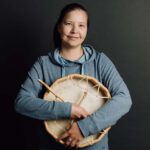
Ada Jules is a proud Secwepemc educator from Adams Lake Band. She holds a Secwepemc Language Immersion Proficiency Diploma and a Bachelor of Education degree from the University of Victoria. Ada is a former student of Chief Atahm School and now teaches Grade 3/4 immersion at Chief Atahm School. She is dedicated to fostering language revitalization and cultural learning.
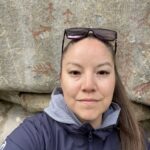
Charmayne Jules is from Cstelen (Adams Lake) but resides in Sexqeltqin (Adams Lake reserve) in Chase, BC. She is Secwepemc from her dad’s side and Nlak’pamux
from her mother’s side. Charmayne has 3 children, Graydon, Tegan, and Olivia. She is a teacher with School District 73 and currently works as the On the Land resource teacher at the Henry Grube Education Center. Charmayne enjoys spending time outdoors and on the land, and finds it fitting that she can do that as a teacher in the public school system. She shares everything she knows about the land with students to help them engage and understand the importance of outdoor education. Charmayne will also be completing her Master’s in Education this fall at UBC.
This workshop explores how place-based learning can be meaningfully implemented in both Indigenous-based schools and public school settings by centering the land as teacher and grounding education in local context. Participants will engage with approaches that weave together land-based learning, Secwepemc language, cultural practices, and community knowledge systems.
Through discussion, reflection, and practical examples, the session highlights how Indigenous ways of knowing and doing—such as relationality, observation, storytelling, and experiential learning—can inform curriculum design and classroom practice. Participants will consider how learning on and with the land supports student identity, well-being, and deeper connections to community and environment.
Educators will leave with strategies for creating learning experiences that are authentic, place-responsive, and grounded in respect for Indigenous knowledge systems.

Helping families raise amazing children in our beautiful Secwepemc language and culture. Call today for a tour or to talk about what our program can offer you and your family.